
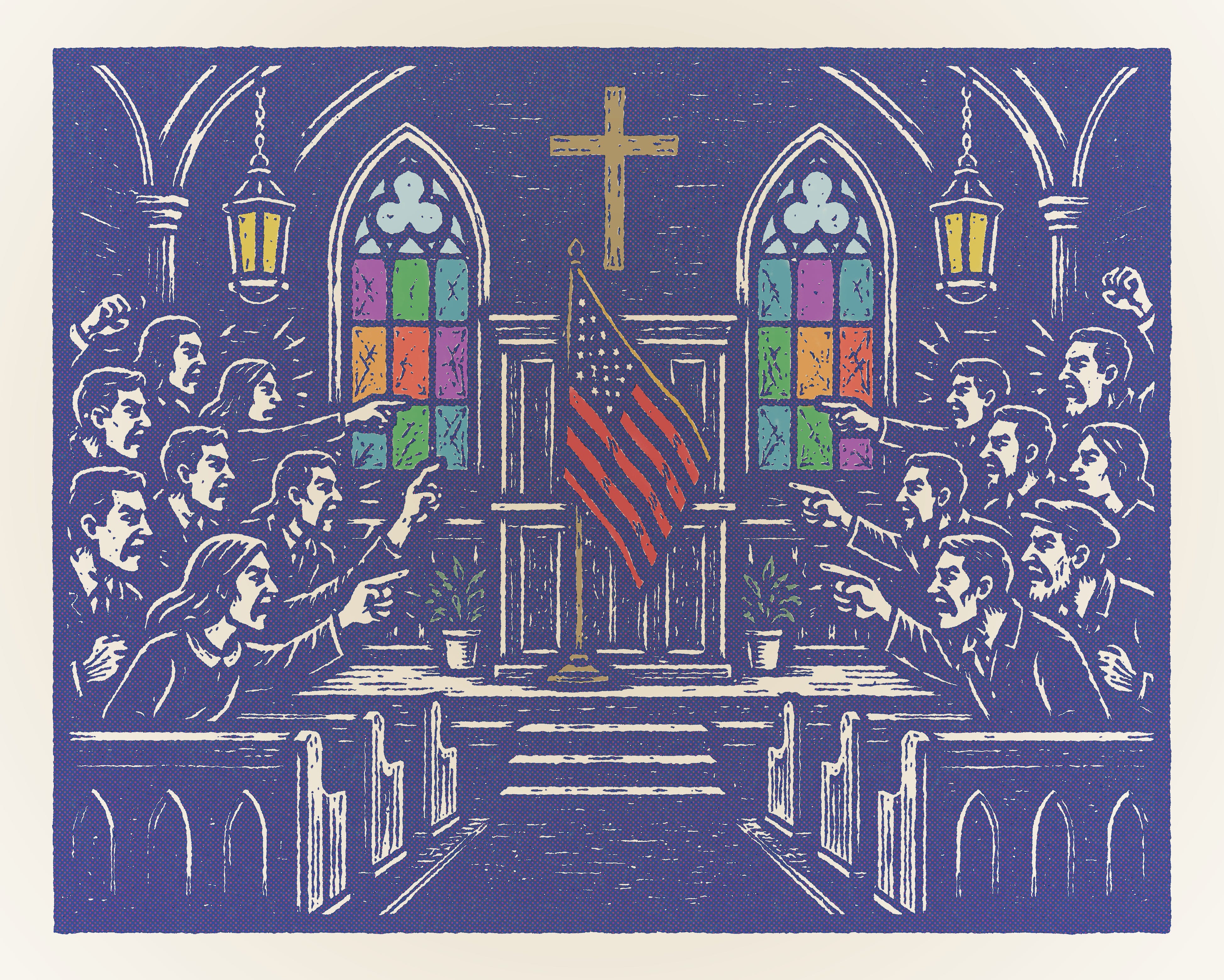
Several years ago, while pastoring in San Diego, I found myself in the middle of one of those moments. It was late one evening in the cramped little church office. A few church leaders were gathered, casually talking, when suddenly another leader burst into the room and shouted, “Who moved the flag?”
The air grew tense. Voices rose. Lines were drawn.
On the surface, it appeared to be nothing more than a disagreement over church décor. One side was adamant that the flag belonged there. It represented the tradition they had always known, their gratitude for the country they loved, and God’s faithfulness through generations. The other side was equally convinced it had no place in the sanctuary. The flag, they argued, blurred the line between love of country and worship of God, confusing the order of our allegiances.
Looking back, I’m not sure either side was actually arguing about the flag. They were arguing about what it represented. More than that, they were arguing about what they feared losing.
One side feared losing gratitude for the nation God had providentially given them. The other feared losing the uniqueness of Christ’s lordship by wrapping it too tightly in the symbols of a republic. Both fears were real. Both were rooted in convictions worth taking seriously. Yet within a matter of minutes, fear had begun doing what fear almost always does. It stopped listening. It assumed motives. It hardened suspicions. It made fellow Christians look like opponents.
I’ve thought about that evening often over the past year as America approaches her 250th anniversary. Somewhere along the way, I realized I had become far more comfortable critiquing my country than loving it. In some circles, patriotism had become almost a dirty word, as though the only faithful Christian posture toward one’s nation was perpetual suspicion. In other circles, the nation had become something dangerously close to sacred, draped in language that belonged to Christ alone. Neither instinct ever sat comfortably with me. One seemed unable to confess national sins. The other seemed unable to acknowledge national gifts.
The older I become, the less interested I am in choosing between those two errors. A Christian should be able to love his country without worshipping it. He should be able to tell the truth about its failures without denying the good he has received from it. Gratitude and repentance are not enemies. They are close friends throughout Scripture. In fact, Christians ought to be the one people capable of both. We worship a Savior who teaches us to give thanks for daily bread while also confessing our sins every day. The gospel leaves no room for either triumphalism or cynicism.
It was Joshua 22, of all places, that helped me begin putting words to something I had struggled to articulate. At first glance, it is an unusual chapter. There are no collapsing walls, no giant-killing shepherds, no dramatic miracles. Instead, the chapter revolves around an altar that was never meant to be used. It is one of those passages we are tempted to read quickly because nothing obvious seems to happen. Yet this quiet story contains one of Scripture’s most perceptive observations about human beings. We instinctively build visible things to preserve invisible loyalties. We erect memorials because we know memory fades. We pile stones beside rivers, carve names into marble, raise flags over buildings, preserve family photographs, wear wedding rings, and gather around graves because we fear that what matters most will eventually be forgotten.
The Altar Beside the Jordan
Every good story has a past, and Joshua 22 is no exception. The chapter opens with an enormous altar standing beside the Jordan, but the reasons for its construction lie years earlier, before Israel had even entered the Promised Land.
Some ten to fifteen years before the events of Joshua 22, Israel stood on the edge of the Promised Land. The tribes of Reuben, Gad, and the half-tribe of Manasseh looked east of the Jordan River and saw fertile pastureland, ideal for their flocks. They asked Moses if they could settle there rather than west of the river with the rest of Israel. It was an unusual request, and Moses agreed, with one condition. They would first cross the Jordan and fight beside their brothers until the land had been secured.
They did. They fought. They bled. They kept their word. And years later, with the conquest complete, Joshua finally released them to return home. The promises had been fulfilled. The land had been divided. Israel had rest. For these two-and-a-half tribes, the long march home had finally begun.
Yet before crossing back over the Jordan, they built an altar. It was no modest structure. Joshua describes it as “an altar of imposing size,” one that stood beside the river in a way no one could overlook. News spread quickly through the western tribes, and they reached the only conclusion that seemed possible. Another altar had been built in Israel.
Their reaction was not irrational. They remembered Achan, whose hidden sin had brought judgment upon the entire nation. They remembered Baal Peor, where Israel’s flirtation with false worship had nearly destroyed them. God had appointed one altar for sacrifice. Another altar suggested another place of worship. Another place of worship suggested another god. Israel gathered at Shiloh to make war. Before an army crossed the Jordan, however, they sent Phinehas the priest and ten tribal leaders to confront their brothers. His opening question left little doubt about what they believed had happened. “What is this breach of faith that you have committed against the God of Israel?”
Only then does Joshua reveal what no one west of the Jordan had understood. The eastern tribes had no intention of building another place of worship. They knew there was only one altar appointed for Israel’s sacrifices. They had built this structure as a witness. It stood beside the Jordan, declaring something they feared later generations might forget. We belong to the Lord too.
The western tribes feared compromise. The eastern tribes feared being forgotten. They feared that one day the western tribes would look across the Jordan and no longer see brothers. Those who had once fought shoulder to shoulder would become people they only heard about. Friends would become acquaintances. Shared history would slowly become someone else’s history. Time rarely severs those bonds all at once. It wears them away almost imperceptibly until one day people who once felt indispensable occupy little more than the margins of our lives.
The eastern tribes told Phinehas, “In time to come your children might say to our children, ‘What have you to do with the Lord, the God of Israel?’” The Jordan River had once united Israel. They feared one day it would become a boundary between “us” and “them.” Geography becomes identity. Identity becomes suspicion. Suspicion becomes history. The memorial stood beside the river to answer that accusation before it was ever spoken.
It is not hard to understand that fear. People do not have to become enemies to become strangers. Most of us have lived long enough to watch distance rewrite relationships. Children grow. Parents age. Friends build lives that no longer intersect with ours.
That is why every civilization builds memorials. We erect monuments, preserve battlefields, collect photographs, celebrate anniversaries, and tell family stories because we instinctively know that what is not remembered is eventually lost. The eastern tribes simply did what every generation has done before and since. They built a memorial to fight against time. They could not have imagined that the very thing they built to preserve unity would bring Israel to the brink of civil war.
Yet, this is one of the strange limitations of every memorial. Memorials preserve memory, but they cannot preserve meaning. Every monument eventually requires an interpreter. Every tradition eventually has to be explained. Every symbol outlives the generation that instinctively understood it. The farther we move from the people who built it, the more likely we are to misunderstand why it exists at all.
This is hardly unique to Joshua 22. Walk through Washington, D.C., and you will find monuments that inspire some, offend others, and confuse many more. The stone itself cannot settle the argument. It cannot tell its own story. The same is true of church buildings, family heirlooms, denominational traditions, military cemeteries, stained-glass windows, wedding rings, and yes, even flags. Symbols are powerful precisely because they point beyond themselves. The difficulty is that they never control what people think they are pointing toward.
That is why every generation eventually begins arguing about its memorials. And what are we arguing about? It’s about competing stories. We are asking what deserves to be remembered, what deserves to be forgotten, and what those memories require of us. The argument over the flag in that small church office all those years ago was not fundamentally about interior decorating. It was about whether displaying a national symbol inside a sanctuary clarified Christian gratitude or confused Christian allegiance. The flag itself could answer neither concern. It simply stood there while everyone else supplied its meaning.
Living with Joshua 22
Joshua 22 leaves me with three observations.
The first is that this story should have ended with bloodshed. Yet, it didn’t because one man refused to let suspicion have the final word. Before Israel crossed the Jordan with swords, Phinehas crossed it with questions, and he didn’t condemn his brothers before hearing them. This is rare. It is much easier to defeat the version of someone we have imagined than the person actually standing in front of us.
The second is that sincere people can arrive at completely opposite conclusions while trying to protect the same thing. The western tribes feared compromise. The eastern tribes feared being forgotten. One built a memorial. The other prepared for war. Both were concerned with covenant faithfulness. Yet from either side, fear was a poor interpreter.
The third is the one I cannot escape as America approaches her 250th birthday. Memorials matter. They teach gratitude. They remind us of sacrifice. They anchor a people to a shared story. God Himself repeatedly commanded His people to remember. Yet memorials cannot carry the weight we often ask them to bear. Stone cannot preserve virtue. Bronze cannot create gratitude. A flag cannot produce loyalty. Memorials can remind us who we are. They cannot make us who we ought to be.