
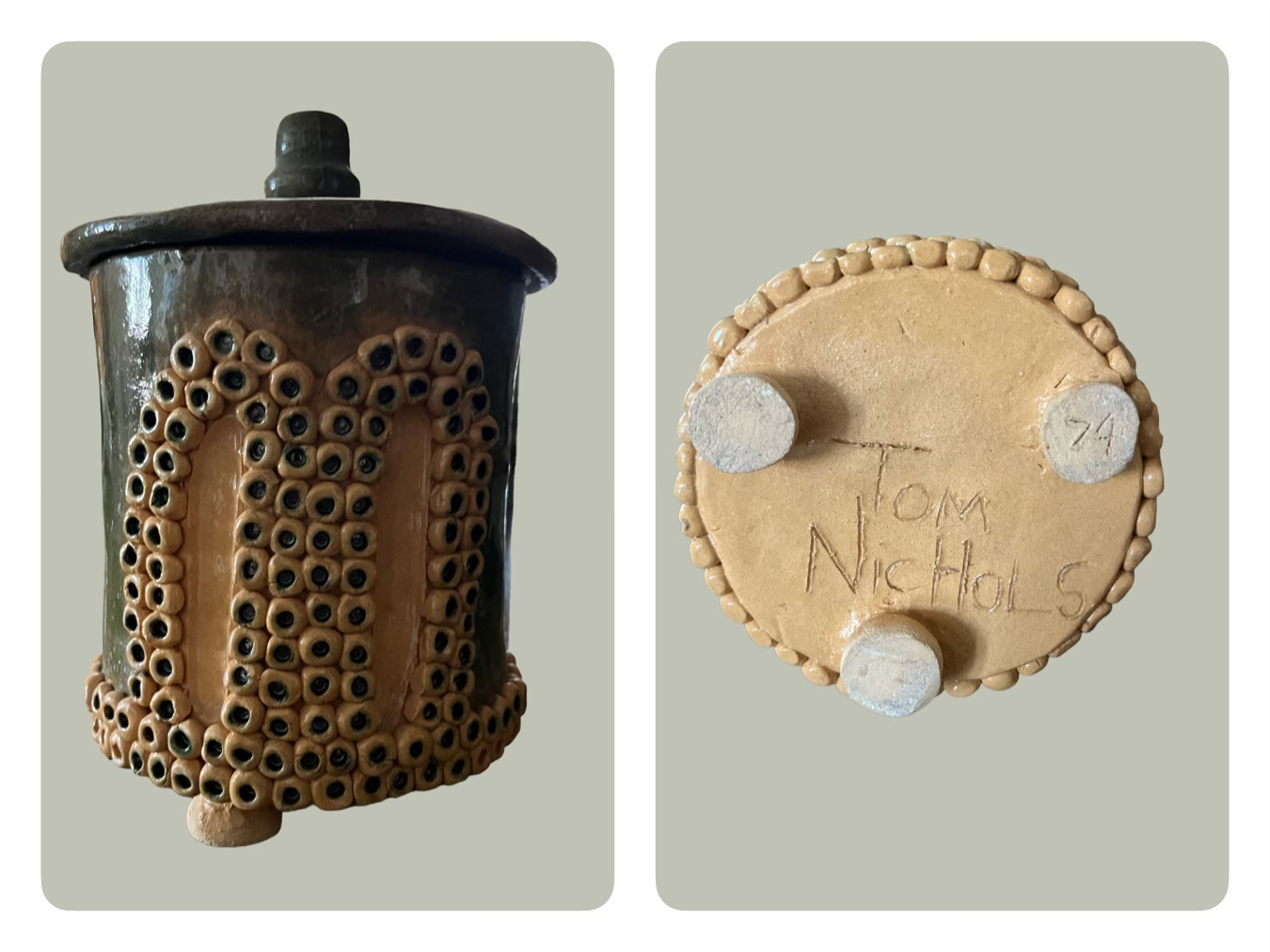
My dad has a cookie jar he made in 1974 as a teenager. It’s lopsided, the glaze is uneven, and the lid never quite sits where it should. For as long as I can remember, it has lived somewhere in the background of our house—on a shelf, on a counter, sometimes tucked away and then brought out again. I never thought much about it growing up. It was simply there, like an old family habit no one bothers to explain.
As I got older, I started noticing how strange it was that this jar kept surviving moves, purges, remodels, and new kitchen gadgets. Plenty of nicer things disappeared over the years—things without cracks, things that actually matched the décor. Yet this odd little jar stayed put. And it’s not as though we’ve been kind about it. We’ve all told him it’s ugly—openly and without hesitation. But he won’t get rid of it. And honestly, he’d be heartbroken if anyone else tried.
Lately, I’ve been thinking a lot about identity. In chaplaincy, it comes up in ways people don’t always name directly. It shows up when someone is rebuilding their life and trying to figure out who they are now. It shows up when the old version of themselves no longer fits.
Who am I now that I’m clean?
Who am I now that my kids aren’t with me?
Who am I now that I’m not in prison?
Who am I now that I’m not the guy everyone went to on the streets?
Who am I now that I’m not in that relationship anymore?
People don’t say those sentences the same way every time, but the question underneath is familiar to almost everyone. There are moments in life when the answers we’ve used for years suddenly don’t fit anymore. Identity gets hard to pin down, not because we’re doing anything wrong, but because life has shifted in a way we didn’t choose.
It can happen in your twenties, when you’re trying to figure out who you are for the first time.
It can happen after a divorce, when you’re no longer someone’s husband or wife.
It can happen when the house gets quiet and the people you built your life around step into their own.
It can happen when your body no longer lets you do the things that once defined you.
It can happen when work shifts or ends, and you’re not sure what your place is anymore.
All of us, in one way or another, hit moments when the story we told ourselves about who we are doesn’t quite hold. The old answers don’t stretch far enough into the new season.
With all of this on my mind, I tried to picture how I’d talk about identity with someone sitting across from me. I kept coming back to the difference between contents and container. What’s in something, and what something is for. I wondered what would happen if I used something as simple as a cookie jar to name that difference.
So one week in group, I brought in a glass jar of cookies and set it on the table without saying anything. After a minute, I asked, “What do you see here? Is this a jar of cookies, or cookies in a jar?”
People answered without hesitation, but not all the same way. And that opened up a surprisingly honest conversation. Some people focused on what was inside the jar. Others focused on the jar itself and the role it was meant to play.
In a small way, that’s the same tension most of us feel when we’re trying to understand who we are. Sometimes we turn inward and assume that who we are must come from whatever we’re feeling in the moment. And on the surface, that makes sense. We live with our thoughts and emotions more closely than anyone else. But that doesn’t make them easy to read. Most people know what it’s like to feel two different things at the same time. We want to change, and we also think, “But this is just who I am.” We look back on seasons where we did things we regret and tell ourselves, “That wasn’t really me.” But the truth is, it was us — not the whole story, not the final word, but still part of who we were. We wanted those things as much as we didn’t want them. We were torn even then.
And that’s where the confusion creeps in. If our desires can point in opposite directions… if our values shift under our feet… if the things we feel most strongly today can be replaced by different feelings tomorrow… then which one counts as the “real” us? Which impulse is the truth-teller? Which version of ourselves deserves the name?
It’s not that looking inward is wrong. It’s that it’s complicated. And when we try to build our identity on something as unpredictable as whatever we happen to feel most intensely, it’s hard to know where to stand.
And sometimes identity shows up in an even simpler way. It shows up when someone asks, “So who are you?” Most of us answer with what we do. I’m a father. I’m a husband. I’m a chaplain. For others it’s, I’m a teacher. I’m a nurse. I’m a student. I’m a musician. I’m the one who fixes things. I’m the one who keeps everyone calm. I’m the funny one. I’m the strong one. We don’t think of it as a deep claim; it’s just how we’ve learned to talk about ourselves.
But those descriptions stick with us more than we realize. They become little identities we try to maintain. And when things go well, it feels solid. But when they don’t — when parenting is hard, or work goes sideways, or our creativity gets ignored, or the thing we’re “good at” suddenly doesn’t work, or we disappoint people who expected something from us — it cuts deeper than the moment itself. We don’t just think, “That went badly.” We think, maybe I’m failing at being the kind of person I thought I was.
It’s not that these roles, gifts, or responsibilities aren’t real. They are. They matter. But when “who I am” collapses into “the thing I’m supposed to be good at,” identity becomes fragile. One rough patch, one bad review, one season of feeling out of sync — and suddenly the ground under our feet shifts.
We end up caught between two instincts. The inside that won’t stay still. And the outside that won’t stay the same. Neither one is always wrong, but neither one is solid enough to build a whole identity on. And that’s when my dad’s cookie jar finally made sense to me in a way it never had before.
After fifty years, the jar’s shape didn’t name it. The contents didn’t name it. The label didn’t name it. Its usefulness didn’t name it. One thing explained its identity more clearly than anything else. It stayed because it belonged to someone who loved it.
And suddenly the whole idea of identity shifted. If who we are depends on what we feel, we’ll change every time our feelings do. If who we are depends on what we do, we’ll crumble every time something changes around us. But if who we are begins with the One who made us, sustains us, and refuses to let us go, then identity stops being something we have to hold together. It becomes something received.
I am created by the Father — living on borrowed breath because He wants me here.
I am shaped by the Spirit — living on borrowed time, drawn into a story bigger than my own.
I am redeemed by the Son — living by another’s death because His love has made me new.
My dad’s cookie jar doesn’t stay because it’s impressive. It stays because it’s loved. And if that’s true of a crooked, wobbling piece of clay, how much truer it is of the people God has formed with His own hands?
He doesn’t keep us because we’re shiny. He doesn’t love us because we’ve held our shape. He doesn’t stay because we’ve been consistent. He loves us because we’re His.
He sees every crack, every chip, every regret. He sees the days we feel full and the days we feel empty. And still, He keeps us — not because we earned it, but because His love doesn’t change with our performance.
You were broken enough that Jesus’ death was necessary.
You were beloved enough that He thought you were worth dying for.
So when you think of that old jar—lopsided, uneven, not much to look at—remember this. You are not what you feel today. You are not the role you might lose tomorrow. You are not your best moments, and you are not your worst ones. Your identity rests somewhere far more solid than that. Your identity is the God who made you, the Christ who redeemed you, and the Spirit who shapes you.