
A few years ago, we were hiking along what we thought was an abandoned stretch of train track. It was a long day hike through winding desert hills, broken up by a series of tunnels. Each increasing longer to the point that the light behind you disappears before the light ahead feels real. Sound tightens. Footsteps echo. Your eyes adjust, but not enough. It is still just dark, except for the small, piercing point of light far ahead.
It was in the second or third tunnel that we heard it. A horn. Distant but unmistakable. The kind your mind rushes to explain safely. Another hiker, maybe. Someone signaling with an air horn farther down the line.
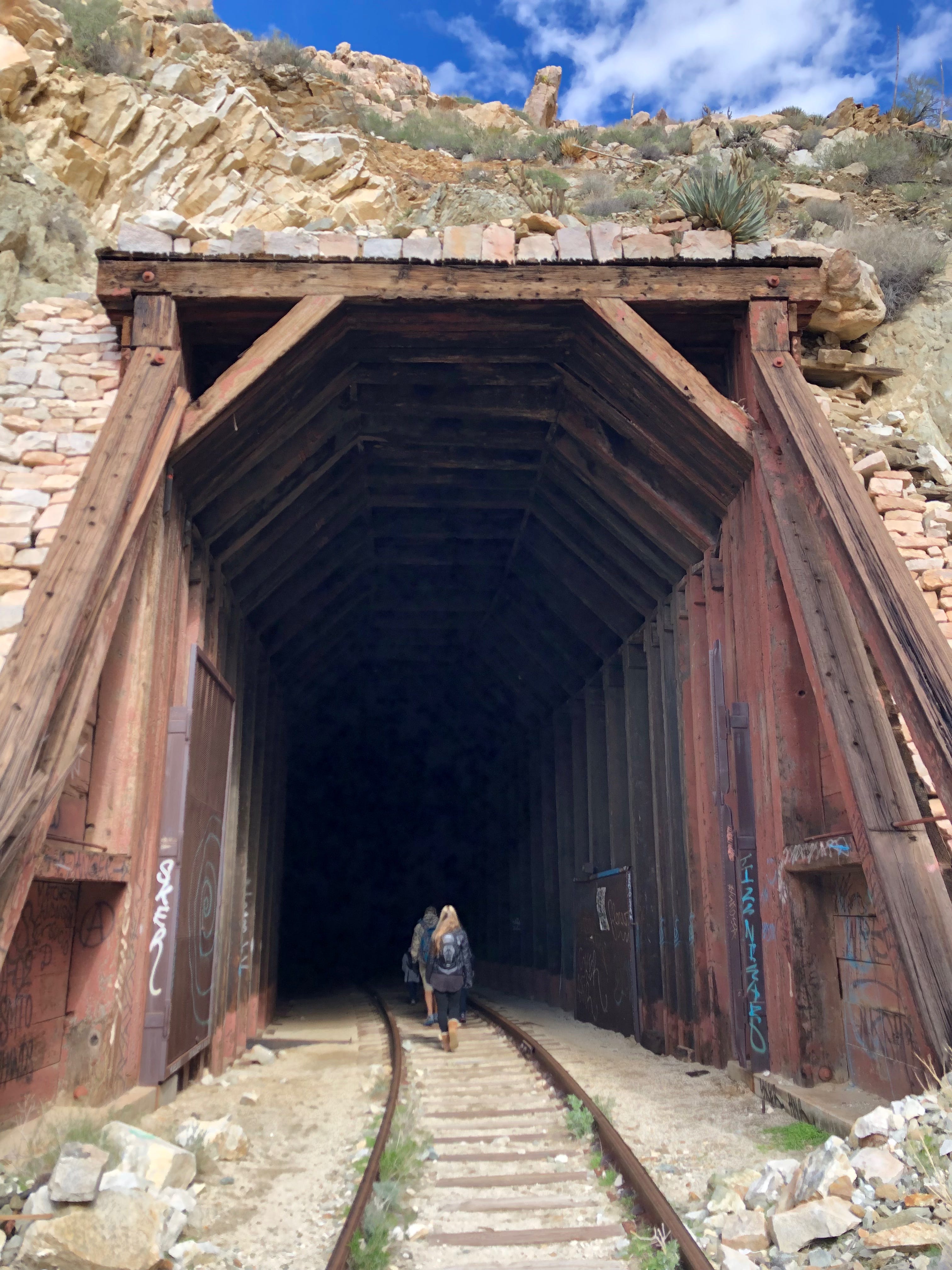
None of us allowed ourselves to even consider that it could be a train. The tracks had been abandoned for years. Yes, there had been rumors about a future sightseeing tour, but nothing official.
Then the horn sounded again. Too big to be a consumer airhorn. And then we felt it. The track beneath our feet began to vibrate.
In that moment, everything narrowed at once. The tunnel that had felt spacious suddenly felt impossibly small. Pressing ourselves against the wall while a train passed felt like a gamble no one wanted to test.
There was no time to consider better ideas. We were too far in to turn around. The exit was still far ahead. Running toward what might be coming made no sense. And so with no better options, we ran toward the light ahead.
Horn blaring behind us, one of us went down. Someone reached back and pulled them up and we all stopped to face the unescapable together.
Then it came into view. A small maintenance cart rolling down the tracks. We stood in relief and confusion as it approached. Two workers in jumpsuits and helmets swept flashlights across our faces, followed by a few questions and a brief lecture about how the tracks, while not in use, were still private property of the rail company.
What has stayed with me all these years is not the fear itself, but the speed of it. How quickly imagination collapsed. In seconds, the future took on only one shape. Get out or die.
Fear did not lie to us. It simply stripped everything else away.
That is how fear works. It does not begin by asking bad questions. It begins by asking urgent ones. Questions that press instead of invite. Questions that shorten time and narrow options until the future feels like something bearing down on you.
What if this goes wrong?
What if you fail again?
What if you trust and regret it?
What if you lose control?
What if they leave?
What if you finally hope and it costs you more than you can afford?
Each of these questions comes with its own imperatives and injunctions. What must I do. And just as quickly, what can’t I do. Those limits begin to shape what kind of future you think is even available. In short, fear edits the future until it is no longer a place you are going. It becomes a threat you are managing.
I see this constantly in pastoral care.
What if I mess up my kids again?
What if trying only proves that I really cannot change?
What if I open up and get rejected?
What if I stop controlling this and everything falls apart?
What if God does not show up this time?
Each question tightens the space a little more. Each one adds another boundary, another condition, another unspoken rule about what is allowed. The future doesn’t vanish all at once. It gets trimmed. First to a few options. Then to two. Either this or that.
If you have ever thought, things will either go like this or like that, you know the feeling.
Fear keeps narrowing the field. Fewer options. Less imagination. Less room to move. Action becomes reactive rather than free. You do not choose so much as respond. Over time, even the light you are moving toward begins to fade, and despair stops feeling like an emotion and starts to feel like a conclusion.
Hope does something different.
It asks a different kind of question.
Not, what must I do, but what can I do.
What if this is not the end of the story?
What if the future is not determined by what has already happened?
What if there are possibilities here you cannot yet see?
What if God is more active than your fear allows?
What if grace reaches further than your worst-case scenario?
What if obedience is not about avoiding collapse, but about stepping into life?
Those questions do something different to the body. They restore space. The future begins to open again.
Hope reintroduces outcomes we cannot manage. It does not promise outcomes. But it does insist that the future is larger than our worst memory and stronger than our present threat assessment. Hope admits that God may act in ways we did not predict. Hope loosens our grip on the story and asks what can be done because God is not finished.
What can I do if the future belongs to God?
What can I do if failure is not final?
What can I do if obedience is not a gamble, but a response to a secured ending?
What can I do if God’s mercy is larger than my control?
What can I do if resurrection is not a metaphor, but a pattern?
Fear makes people careful. Hope makes people free. And hope is the only thing that keeps fear from becoming the final authority over our lives.
Free to tell the truth.
Free to act without guarantees.
Free to endure without shrinking.
Free to imagine a future that is not simply the past replayed with better behavior.
Fear narrows what is possible and gives us tunnel vision. Hope widens it. It opens the future, clear and wide as a Montana sky.
Oh! How timely for me! Thank you for sharing! I find myself always hedging for guarantees, protecting myself from loss and decreasing my aptitude for mistakes. But God makes room for my mistakes. He wants me to hope, to be adventurous, to help me in these great endeavors! "If God is fir me, who can be against me?"