
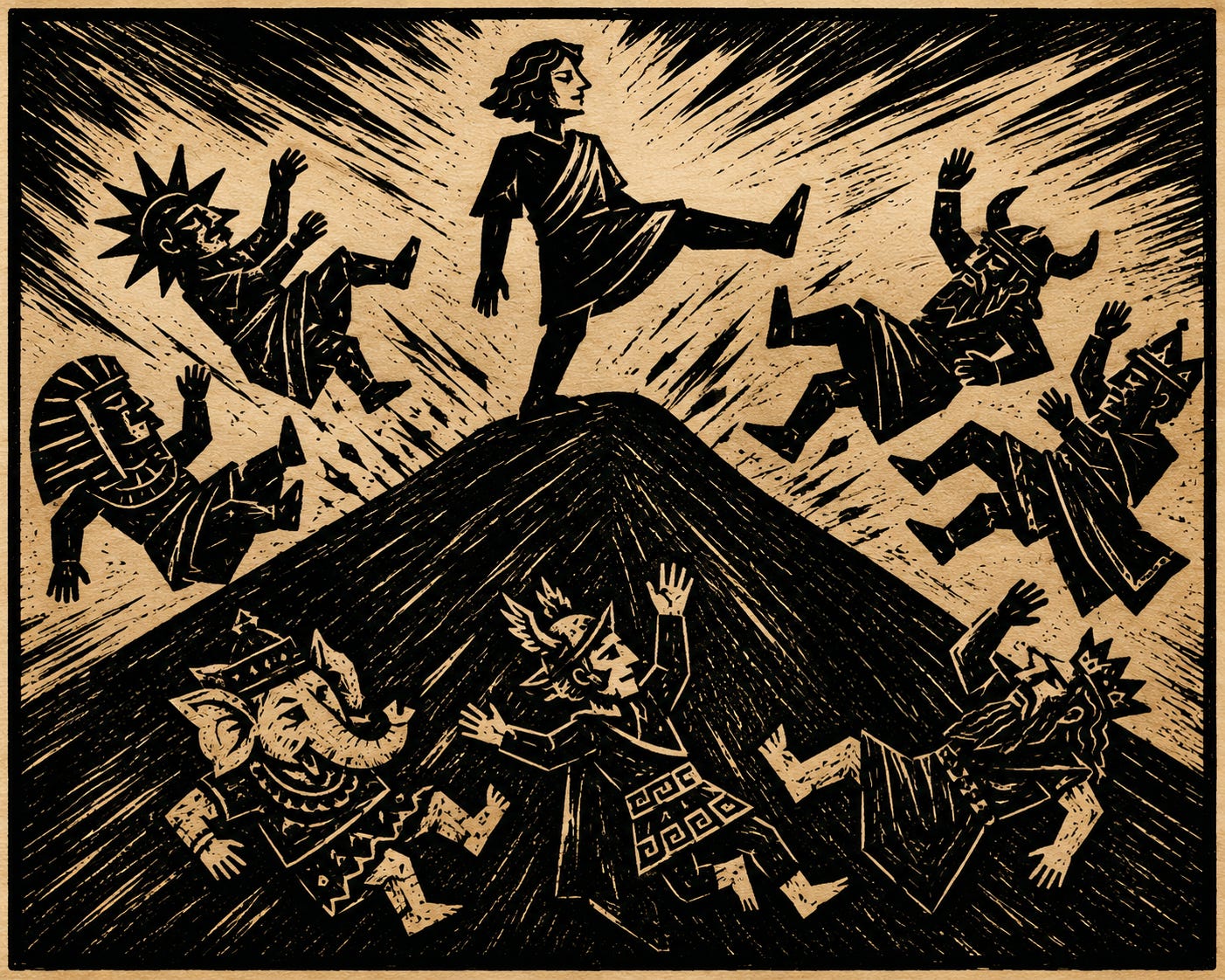
Tom Holland's Dominion, Glen Scrivener's The Air We Breathe, and more recently the public debates and videos of Mike Jones (Inspiring Philosophy) all exemplify a growing contemporary apologetic. The historical fruits of Christianity are presented as compelling evidence for its truth. Human rights, the dignity of women, the protection of children, hospitals, universities, the abolition of slavery, and the moral instincts of the modern West are all traced back to the influence of Christ and His Church. Christianity produced a more humane civilization. Therefore, Christianity should be taken seriously.
I find these arguments compelling. Like many apologetic arguments, they strengthen my own confidence in the truth of Christianity. Whether they are equally persuasive to those who do not already believe is another question. A friend recently observed that apologetics often reassure believers more effectively than they convert skeptics. He may be right. My concern here, however, lies elsewhere. These arguments are fascinating not simply because of what they argue, but because of how they argue. They reveal something about the Christian imagination of our own age.
A fourth-century Christian would have looked at exactly the same evidence and reached a different conclusion. He would not have said, “Christianity must be good because it produces flourishing.” He would have said, “Christ must be King because He has conquered the nations.”
The change reaches beyond apologetics. It reaches into the Christian imagination. Christianity is increasingly presented as something the world should admire before it is asked to submit to it. The faith is commended through its compassion, its charity, its schools, its hospitals, its concern for the weak, and the civilization it has produced. The hope is that once Christianity is seen as beautiful, it will also be seen as true. Beauty, it is often said, will save the world.
That instinct would have been largely foreign to earlier generations of Christians. They did not expect Christ to become more persuasive by first becoming more palatable. The nations were not invited to admire a better way of life. They were summoned to repent before their rightful King.
The shift does not end with apologetics because apologetics always rests upon a deeper imagination of reality. The way Christians explain why Christianity is true eventually shapes the way they read Scripture, understand the Church, preach the gospel, think about politics, interpret history, and even imagine Christ Himself. A civilization commended by its moral beauty produces one way of seeing the world. A kingdom advancing under the authority of its King produces another.
The New Testament reads history with the same categories. Peter does not merely announce that Jesus has risen. He declares that God has made Him “both Lord and Christ.” Paul does not simply preach forgiveness in Athens. He announces that God has fixed a day on which He will judge the world through the Man He has appointed. The Great Commission begins with universal authority because universal authority explains the mission that follows. The apostles do not interpret the conversion of the nations as the triumph of a more compelling philosophy. Throughout Acts, idols fall. Temples are threatened. Sorcerers burn their books. In Ephesus, the craftsmen fear that Artemis herself “will be deposed from her magnificence.” The gospel advances because rival worship retreats. Paul commends the Thessalonians because they “turned to God from idols to serve the living and true God.” Revelation closes where the story has always been headed, “The kingdom of the world has become the kingdom of our Lord and of His Christ.”
Likewise, the Fathers read history with the categories Scripture had given them. Athanasius looked upon abandoned temples and silent oracles and saw the triumph of Christ over the gods who had once deceived the nations. “Behold how the Savior’s doctrine is everywhere increasing, while all idolatry... is daily dwindling, and losing power, and falling.” Justin Martyr spoke of the gods of the nations as demons whose dominion had been broken by Christ. Origen answered Celsus not by appealing to Christianity’s usefulness but by pointing to its astonishing advance through the empire. Eusebius interpreted the conversion of nations as the kingdom of Christ becoming visible in history. The Martyrdom of Perpetua and Felicitas assumes the same world. Rome possesses the sword. Christ possesses the kingdom. The empire passes judgment upon the martyrs for an hour. Christ will pass judgment upon the empire forever.
Christian political thought naturally followed. Kings and rulers were not addressed merely as citizens with moral responsibilities. They were addressed as men who belonged to Christ. Psalm 2 was read as a command to rulers, not merely as a prophecy about Christ. The Great Commission began with authority because authority explained the mission that followed. Religious liberty was defended because faith cannot be compelled, not because every object of worship possessed equal legitimacy. False worship remained false worship. The first commandment did not cease to apply because a government lacked the authority to produce genuine faith.
Christian mission and evangelism have reflected the same shift. The gospel is increasingly introduced through human need rather than Christ’s kingship. Loneliness, guilt, shame, anxiety, purpose, belonging, and meaning become the point of contact. The apostles began elsewhere. Jesus Christ had been raised from the dead, enthroned above every ruler and authority, and appointed Judge of the living and the dead. Repentance followed because repentance is the proper response to a reigning King. Forgiveness, reconciliation, peace, and eternal life belonged to that announcement because the King had already come.
The center of Christian virtue shifted with everything else. The vindication of God’s name gradually gave way to the flourishing of man. Christian ethics increasingly asked, “What is good for people?” Scripture more often asks, “What glorifies God?” The shift is visible even in the way the Fathers are remembered. Irenaeus is repeatedly quoted, “The glory of God is man fully alive,” as though the sentence were chiefly about human flourishing. It is not. Irenaeus is arguing that God has no need of man. God commands because He is good, not because He lacks anything. Man, by contrast, is utterly dependent upon fellowship with God. “The life of man consists in beholding God.” Human life is not the center of the argument. God’s glory is.
The modern imagination understands history through human flourishing, therapeutic well-being, and individual fulfillment. It therefore increasingly apologizes for Christianity’s victories. The conversion of nations is spoken of with embarrassment. The displacement of pagan worship is treated as cultural loss. Christian influence is welcomed only so long as it remains private, therapeutic, and politically harmless. Religious diversity itself comes to be treated as an unquestioned good, so the disappearance of any religion is instinctively mourned as though humanity has become poorer.
Yet this sits uneasily beside the very apologetic offered by Holland and Scrivener. If Christianity truly liberated the nations from practices that diminished human dignity, why should Christians hesitate to celebrate the passing of the religions from which those nations were delivered? We gladly celebrate the fruits while apologizing for the tree that bore them. We celebrate hospitals, the protection of children, and the dignity of women, yet speak of the defeat of pagan worship as though it were a tragic loss.
Scripture and the Fathers knew no such tension. They grieved for idolaters, not for idols. The prophets did not mourn when Baal lost his worshippers. The apostles did not regret that Artemis was “deposed from her magnificence.” Athanasius did not lament abandoned temples. They received these events as public testimony that the living God had acted. The spread of Christianity was not celebrated because Christians had become more persuasive. It was celebrated because Christ was demonstrating His dominion. False gods were not cultural treasures awaiting preservation. They were rivals that had lost their kingdoms.
The disagreement finally concerns what history is allowed to prove. Modern Christians increasingly ask history whether Christianity is beneficial. Earlier Christians asked what history revealed about God. Both readers look upon the same hospitals, the same conversions, the same collapse of pagan worship, and the same transformation of civilization. One concludes that Christianity deserves admiration because it has improved the world. The other concludes that Christ has publicly demonstrated His lordship because the gods of the nations have lost their kingdoms.
Why does this older imagination now feel so unsettling? Because modern Christians have learned to associate victory with domination and domination with injustice. We instinctively assume that if one religion triumphs, another people must have been wronged. We have become reluctant to believe that history can publicly vindicate the claims of one God over another. Victory itself has become morally suspect.
I first encountered this instinct years ago in Peter Rollins’ parable “God Joins the Army,” from The Orthodox Heretic: And Other Impossible Tales. Rollins was one of the more recognizable voices in the Emerging Church movement, a close friend and frequent collaborator of Rob Bell during a period that helped shape many of the instincts later associated with post-evangelicalism and deconstruction. I have not thought about the story in years, but it has stayed with me because it expresses an instinct that has since become increasingly familiar.
An island is invaded by a vastly superior army. Before the battle, an oracle announces that God Himself has joined the invading force and placed all His power behind it. The island’s leaders immediately debate whether to surrender or flee, convinced that defeat is inevitable. The chief nevertheless chooses to fight, and against every expectation his people prevail. When the bewildered oracle asks how he dared oppose an army backed by God Himself, the chief replies, “It does not matter which side God is on. When God is involved, the oppressed always win.”
The story is more than provocative. It teaches the reader how to interpret history. The decisive question is no longer whether history has vindicated the living God. The decisive question is who occupies the place of the oppressed. Once that becomes the controlling lens, every triumph is reinterpreted as domination, every defeat as innocence, and every claim that history reveals the judgment of God becomes morally suspect.
This argument should not be confused with the claim that every act committed in Christ’s name has therefore been just. Scripture itself distinguishes righteous rule from tyrannical rule. My argument is simpler. The public acknowledgment of Christ’s kingship by peoples, laws, and nations is a good to be desired, not an embarrassment to be explained away. Historic Protestantism did not apologize when Christian worship shaped public life or when civil laws reflected Christian moral convictions. It regarded these developments as signs of Christ’s reign in history, while still recognizing that rulers remain accountable to God’s justice.
If that older imagination is correct, Christians should not apologize when history reflects it. Dominion is not an unfortunate chapter in Christian history. It is one of Scripture’s central themes. Humanity was commissioned to exercise dominion in Genesis. The Son was promised the nations as His inheritance in the Psalms. The Son of Man received dominion over every people, nation, and language in Daniel. The risen Christ declared that all authority in heaven and on earth had been given to Him. Revelation ends with the kingdoms of this world becoming the kingdom of our Lord and of His Christ. Christians should rejoice because their King is receiving what the Father promised Him.
Christians must once again learn to think, pray, preach, worship, labor, vote, govern, educate, and raise their children as those who believe that Jesus Christ truly possesses the nations by right. The Church cannot be content merely to survive within history. It must once again expect history to bear witness to its King. Every conversion, every church planted, every family restored, every law brought into greater conformity with God’s justice, every idol abandoned, every people taught to obey Christ is another testimony that the kingdom announced by the prophets has entered the world and will not be shaken. The Church does not wait for Christ to receive His inheritance. It lives because He already has.