
My patients had an unfortunate habit of finding comfort in the wrong theology.
Outside the hospital, I had never encountered quite so many Calvinists. Yet in the trauma bay and ICU, I seemed to meet them regularly. Most would have been surprised by the designation. They were not defending a confession or making an argument about predestination. They were lying in a hospital bed, confident that God was in control. More than that, they believed he had done this for a reason.
What did they mean by “a reason”? It is doubtful that they meant that their suffering was the regrettable price of preserving a world in which people could choose good or evil. They believed God had some good purpose for this particular suffering. They could not identify it, but they trusted that it was sufficient to justify what he had allowed.
I came from a non-Reformed theological background. From what my patients reported, so did they. Yet they spoke with a confidence in God’s sovereignty and providential purposes that surprised me. The longer I have served as a chaplain, the more often I have encountered this response from hospital rooms to NA groups.
What made this especially striking was that books on pastoral care had repeatedly warned me against telling sufferers precisely what they were telling me. Kate Bowler’s 2018 memoir, Everything Happens for a Reason: And Other Lies I’ve Loved, captured that warning in a memorable title. Her account of cancer and the collapse of assumptions about blessing and control deserves more than a rebuttal to its cover. There are lies here worth abandoning. The question is whether confidence in God’s providence belongs among them.
There is a vast distance between “I cannot tell you why this happened” and “God has no reason for allowing it.” My patients had no explanation for their suffering. Yet they believed God had one. Their confidence raises a question that advice about what to say at a bedside cannot settle: Does God have a good purpose for the suffering he allows?
Permission Is Not an Alibi
At this point, someone will object that the Reformed account means more than saying God allowed the suffering. It says the event belonged to his decree. By “decree,” Reformed theology means God’s eternal purpose determining what will occur. Ephesians 1:11 describes God as the one “who works all things according to the counsel of his will.” The claim is that events unfold according to a purpose God brings about. If so, is “permission,” then, simply a gentler word brought out when the implications become uncomfortable?
No. To permit something is to allow it to proceed without preventing it. That can itself be planned. God’s decree includes the means by which an event occurs, including his decision to let someone act on an existing desire rather than restrain him. Permission describes how the event occurs within providence. It does not withdraw the claim that God ordained it.

Put a skateboard on a hill and let it roll. Once it is moving, allowing it to continue differs from stepping in front of it. That remains true even if you put it there intending it to roll downhill. You arranged the situation, and you allowed the movement. Both descriptions are accurate.
People, of course, have intentions that skateboards lack. The illustration makes only the narrow point that allowing something to proceed can be the means by which a prior intention is accomplished. “Permitted” does not have to mean “unplanned.”
So far, we have only cleared up the language. We have not justified the permission. If you send the skateboard hurtling downhill into your neighbor’s car, “I merely let it roll” may be descriptively and linguistically acceptable. However, your neighbor will still be looking for a morally sufficient reason not to hold you culpable.
Likewise, why would God ordain that an evil be permitted when he could prevent it? By evil, I mean a distortion of the good God created. Human wickedness, disease, death, and suffering all belong within that category.
Reject the Reformed account of providence, and the question remains. The Roman Catholic Catechism also teaches that God permits moral evil while respecting creaturely freedom and knowing how to bring good from it. Among the accounts now found within Protestant theology, Arminianism holds that God foreknew the evil that would occur without determining the choices that produced it. Molinism holds that God knew what free creatures would choose under every possible set of circumstances and chose which circumstances to bring about. Open theism denies that future free choices are already settled facts, yet still holds that God knowingly created a world in which freedom carried the risk of terrible evil.
Only process theology escapes the question in this form, and it does so by leaving historic Christian orthodoxy. Its God does not sovereignly permit an evil he could prevent. He lacks the power to prevent it.
The Price of Keeping Our Options Open
Among accounts built around libertarian freedom, understood as the ability to choose otherwise under precisely the same conditions, the usual explanation begins with love. God wants creatures who can freely love him and one another. Love cannot be coerced. For love to be genuine, the argument continues, we must be capable of withholding it. God therefore permits the misuse of freedom because freedom makes love possible.
Notice that this is already a greater-good argument. Evil is permitted for the sake of something valuable enough to justify its permission. The libertarian has not escaped that structure. He has nominated freely given love as the greater good and the ability to choose otherwise as its necessary condition. Put less abstractly, every murder, every assault, every war, every abused child, and every family left to grieve become collateral damage in the defense of creaturely freedom.
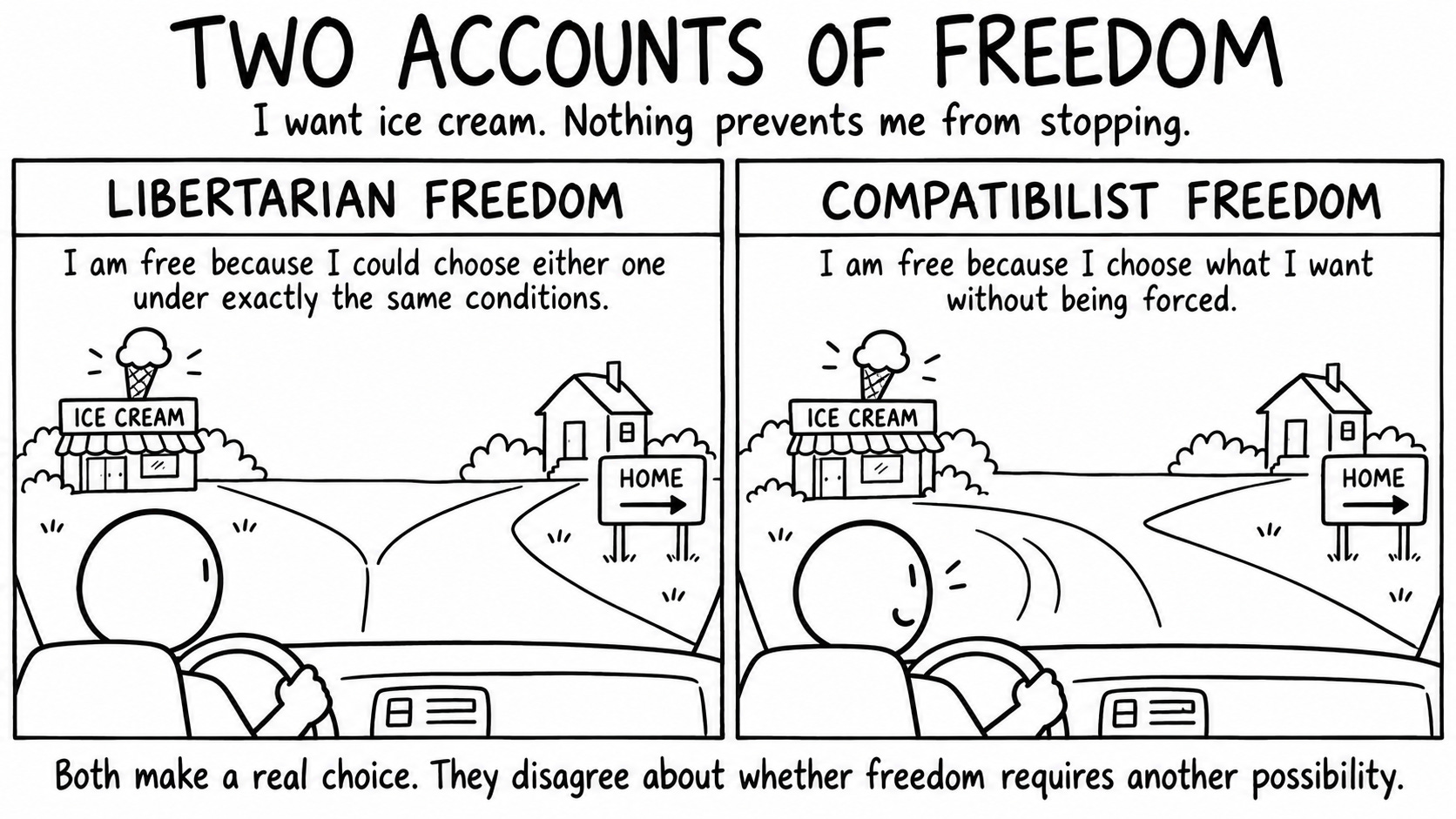
Even granting libertarian freedom, the defense has more work to do. Why must God allow every consequence of a wicked choice? Preventing a murderer from reaching his victim need not prevent him from forming the intention. We restrain people precisely because their choices have become dangerous. Nobody accuses the locked door of abolishing the will.
The free-will defense may explain why God allows people to harm one another. Yet by itself, it does not explain cancer, earthquakes, or other suffering no human being chose. A Christian may appeal to the Fall, regular natural processes, or other goods. But once he does, free will is no longer doing all the explanatory work.
Even where the free-will defense applies, another question remains. Freely given love is good. But is preserving the ability to choose otherwise good enough to justify this much blood? The defense has named a greater good. It has not yet shown that the good is great enough.
Must Love Be Able to Say No?
Whether freely given love is good enough to justify the cost is one question. Whether love requires the ability to choose otherwise is another.
Compatibilism holds that divine determination and human freedom can coexist because a person acts freely when acting willingly from his own desires. This does not make coerced affection love. Affection extracted at gunpoint is a contradiction in terms. But willing does not necessarily mean undetermined. Acting from a heart that loves is different from acting against one’s will. God’s providence can encompass the first without turning it into the second.
“But if God determines what I want, how am I responsible?” That is the serious objection. Compatibilism locates responsibility in my willing action, intentions, and responsiveness to reasons. It does not require me to be the ultimate cause of my own character. The critic may find that insufficient. That is the argument to have. Calling everyone a puppet supplies a caricature where an argument is needed.
God cannot lie, yet Christians do not regard his truthfulness as meaningless. The saints in glory will not need the continuing possibility of revolting against God to keep their love authentic. If the ability to choose hatred is what makes love real, heaven will be a remarkably loveless place.
A Morally Sufficient Reason
None of this explains why God permits a particular evil. Compatibilism explains how human beings can act willingly and remain responsible within God’s providence. It does not claim that God permits suffering in order to preserve our ability to act according to our desires.
Augustine did not finally leave the matter at creaturely freedom. He wrote that God “judged it better to bring good out of evil than not to permit any evil to exist” (Enchiridion 27, p. 33). Freedom may explain why the evil belongs to the creature who wills it. It does not explain why God permits it.
The Reformed answer is that God has a morally sufficient reason, even when he has not revealed what that reason is. This is not an appeal to any benefit we can imagine after the fact. A silver lining is not a justification. The good must be weighty enough to warrant permitting the evil and bound to it in such a way that the good could not be accomplished without permitting it.
The claim is hardest when evil arrives by ambulance. A drunk driver crosses the center line, and someone else wakes up in the ICU. Yet this is where providence becomes hope. Thank God that even this belonged to his decree. Not one broken bone, not one loss of life, is wasted. God is not merely making the best of the wreckage. From the beginning, every moment of that suffering belonged to a purpose wise and good enough to justify its permission, even if the patient never sees that purpose in this life.
Redemption Is Not a Retcon
The cross is the clearest example. The crucifixion was betrayal, torture, and judicial murder. Human beings killed God incarnate. Yet Peter says Jesus was “delivered up according to the definite plan and foreknowledge of God” and then tells his hearers that they “crucified and killed” him “by the hands of lawless men” (Acts 2:23). Their act belonged to God’s plan without ceasing to be evil or ceasing to be theirs.
Comic book readers have a word for changing a story after the fact. A retcon, short for retroactive continuity, revises what happened earlier to serve the story an author now wants to tell. Early Star Wars scripts treated Darth Vader and Luke’s father as different men. George Lucas changed that history while developing The Empire Strikes Back, turning a revision of the original plan into one of cinema’s greatest twists.
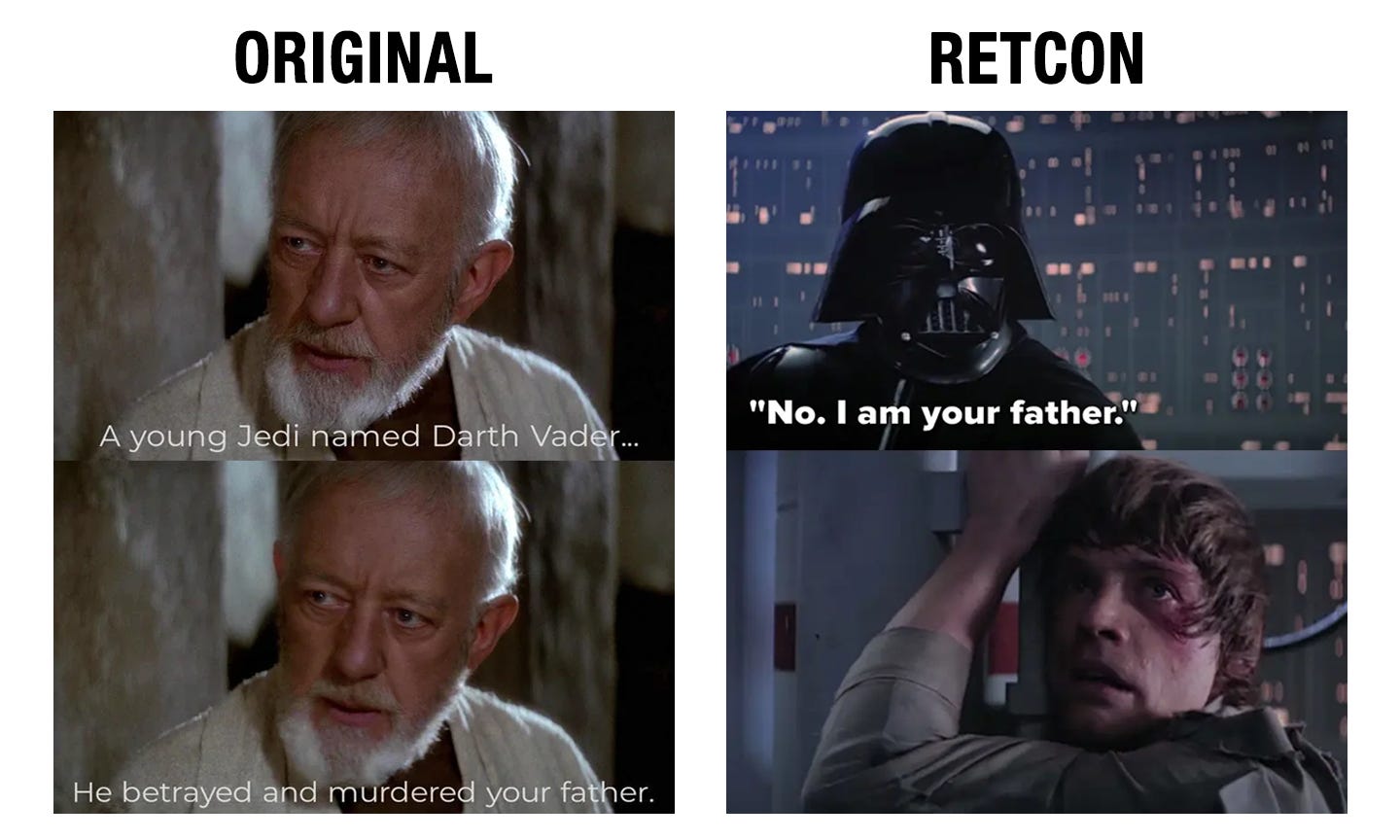
Redemption is not God’s retcon of the crucifixion. God did not look at Calvary and decide how to work it into a happier ending. The cross was the appointed means by which he would forgive sinners, defeat death, and reconcile the world to himself. Here the good was weighty enough to provide a morally sufficient reason, and God accomplished it through the evil rather than merely after it.
The cross does not tell me why any particular patient suffers. It shows that a horrifying evil can belong to a good purpose established before anyone involved can see it. That gives me no license to invent God’s purpose for someone else’s suffering. It does keep me from treating my ignorance as a verdict on God’s providence.
That is why my patients’ words have stayed with me. They were expressing confidence in a purpose they could not see. I still do not know why those patients suffered. But I am increasingly reluctant to correct the confidence with which they told me that God had one.
______________________________
Kate Bowler, Everything Happens for a Reason: And Other Lies I’ve Loved (New York: Random House, 2018).
Augustine, The Enchiridion on Faith, Hope and Love (Washington, DC: Regnery Publishing, 1996), 33.