
I met my first throuple while working as a hospital chaplain. At the time, polyamory still felt unusual enough that I had to learn its vocabulary and understand how the relationship worked.
Since then, I have met an increasing number of people who are living in polyamorous relationships or recovering from them. I now serve as a chaplain in a homeless shelter, where relationship theories eventually collide with housing, parenting, jealousy, abandonment, pregnancy, money, relapse, and the persistent human desire to be chosen. Ideas about love become painfully concrete when someone has nowhere else to sleep.
Polyamory usually arrives in the language of consent, honesty, communication, and personal freedom. Its arrangements vary, yet all depend upon the same extraordinary proposition: a person can be divided. Sexual intimacy may be given to one partner, romantic love to another, emotional security to another, and domestic life and future to another. The self stands above these relationships, assigning each one its sphere. Polyamory requires the person to function as a federation of parts.
The prophets understood worship and sexual fidelity as claims upon the same covenantal self. They described idolatry as adultery because the pursuit of many gods divided the allegiance of a people who had been joined to one God. Solomon’s multiplied wives and multiplied altars formed one spiritual history.
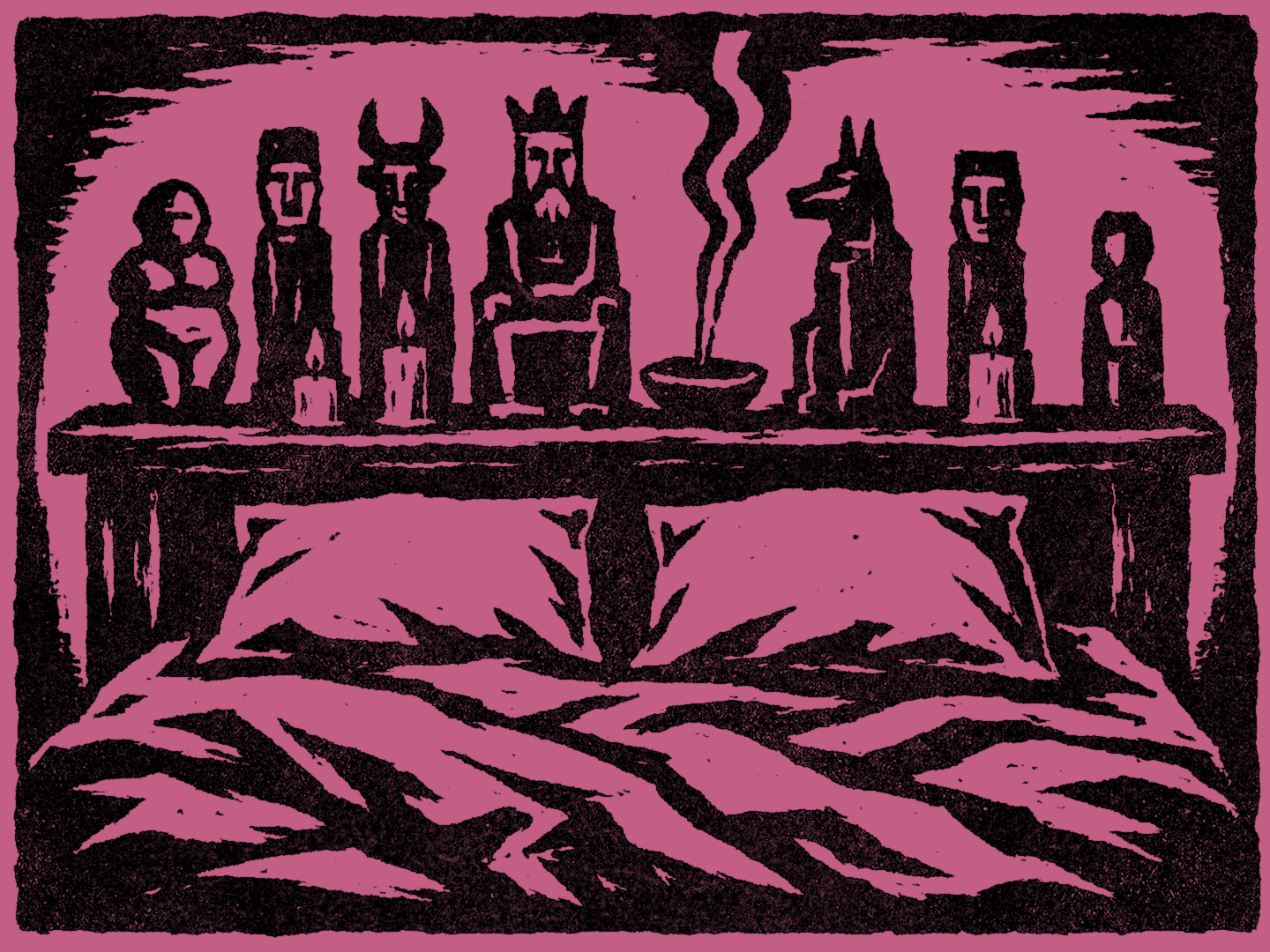
Polytheism supplies the religious grammar of distributed allegiance. Practical Gnosticism supplies the divided person capable of living it. Polyamory brings both into intimate life. The body can be given here, the heart there, the home somewhere else, while the sovereign self stands above the arrangement and assigns meaning to every part.
Christian anthropology begins with the human being as an embodied soul. Body, memory, desire, attachment, and future belong to one living person. When the body joins another, the person goes with it.
Solomon’s Divided Heart
Solomon gives this argument its clearest biblical form. Deuteronomy warned Israel’s future king: “He must not take many wives, or his heart will be led astray” (Deuteronomy 17:17). First Kings records the fulfillment with grim precision. Solomon gathered seven hundred wives and three hundred concubines, and “his wives turned his heart after other gods” (1 Kings 11:3–4). His harem became a pantheon.
Solomon’s marriages belonged to the world of imperial polygyny. Foreign wives established political alliances. Concubines displayed royal power, wealth, and sexual access. Marital accumulation, international loyalty, and religious accommodation became one imperial appetite.
The king who built the temple of the Lord built high places for Ashtoreth, Chemosh, and Molek. Scripture places the multiplied bed and the multiplied altar within one moral history. Solomon divided himself among many women, welcomed their gods, and ceased to be whole before the Lord.
His divided household formed and revealed a divided heart. The divided heart of the king eventually divided the worship of a nation.
Jacob’s Different Household
Jacob’s marriages belonged to the world of kinship polygyny. His love for Rachel was real. Laban’s deception, fourteen years of labor, family obligations, infertility, childbearing, inheritance, and the economic vulnerability of women shaped the household that followed.
Leah and Rachel became wives within one household. Bilhah and Zilpah were servants given as secondary wives for the purpose of bearing children. Each union created economic obligations, descendants, inheritance claims, and permanent relationships between families. Sex was inseparable from household, labor, lineage, and survival.
The Torah later regulated such households by protecting the food, clothing, marital rights, and inheritance of wives and their children (Exodus 21:10–11; Deuteronomy 21:15–17). These laws met damaged social arrangements with concrete obligations toward those most vulnerable within them.
Genesis leaves the misery in plain view. Rivalry between sisters, favoritism among wives and children, servants used for reproduction, bargaining for affection, and women hoping another child might finally secure their husband’s love. The household provided belonging and material security while dividing the affection and fidelity of one husband among several women.
Thus, while historical arrangements differ between Solomon and Jacob, both fracture the one-flesh pattern established in Genesis. Jacob’s many marriages produced one wounded household. Solomon’s many marriages produced a household crowded with nations, loyalties, and gods.
The Greco-Roman Household
The ancient Mediterranean world often practiced legal monogamy inside a wider sexual economy.
Roman law generally recognized one legal wife. It also permitted a free man sexual access to concubines, prostitutes, and enslaved people. Yet, a wife was expected to be faithful to one husband while her husband could have access to several free and enslaved partners. Thus, legal monogamy existed within a broader accepted structure of the polygynous world of slavery and imperial power.
In this setting, a wife secured legitimate children, inheritance, and the continuity of the household. Whereas other women and enslaved bodies could be assigned other functions such as pleasure, companionship, reproduction, status, and domestic legitimacy.
The apostolic ethic confronted this arrangement directly. Paul told Christian men that their bodies belonged to the Lord and warned that sex with a prostitute made them “one flesh” with her (1 Corinthians 6:13–20). The bodily act carried a significance that Roman social rank could not erase. The sexual availability of a woman or slave did not reduce her to an instrument for another person’s appetite.
Christianity demanded from men the sexual faithfulness ancient cultures had chiefly demanded from wives. The body belonged to Christ, and that allegiance governed the bed as surely as it governed the altar.
The Divided Self
Modern polyamory arises from a different social world than the households of Jacob, Solomon, or Rome. Its governing concerns are personal fulfillment, sexual compatibility, emotional authenticity, negotiated consent, and freedom from inherited expectations. These concerns are not merely values applied to relationships. Together, they express a particular understanding of the human self: where identity comes from, who determines the meaning of the body, and what authority our choices have over the obligations created by sex.
That understanding combines three modern impulses. Materialism explains the body through biology, stimulation, hormones, neural activity, and attachment mechanisms. Expressive individualism treats the inward self as the authority on personal meaning. A practical Gnostic reflex then places that authentic self above the body, with the power to decide what bodily acts will mean.
Within this account, sexual acts possess no settled meaning apart from the intentions of those involved. The body supplies the experience, the inward self assigns its meaning, and consent authorizes the arrangement. The central moral question therefore shifts from What does this act mean, and what obligations belong to it? to Did everyone knowingly agree to it?
Consent is morally necessary because it establishes whether an act has been authorized. But permission and meaning are not the same thing. An agreement can authorize an act. It cannot determine everything that act means or erase the attachments, memories, vulnerabilities, and obligations bodily union may create. Consent protects agency. It cannot bear the entire moral weight of sex.
A defender of polyamory may answer that this still misrepresents the relationships involved. Partners need not be assigned separate functions. A person may sincerely love several partners as whole persons, and each relationship may include honesty, tenderness, sacrifice, and care. Polyamory need not mean rationing a limited supply of affection among several people.
This answer is important. The Christian argument cannot rest on the idea that human beings possess only a finite quantity of love. The birth of another child does not divide a parent’s love into smaller portions. Love can multiply.
The question, however, is not simply how many people can be loved. It is what form each love takes and what obligations belong to it. Parenthood, friendship, neighbor-love, and marriage make different claims upon a person. Parenthood is plural by its nature: a parent can give himself or herself fully to several children without altering what parenthood is. Christian marriage makes a different kind of claim. It gathers sexual intimacy, bodily fidelity, household, kinship, and future within an exclusive covenant.
Polyamory places plurality inside this conjugal domain. Some arrangements distribute its goods among different partners: sexual intimacy here, domestic life there, emotional priority somewhere else. Other arrangements attempt to share sexual, romantic, and domestic life more fully among several partners. The second form may avoid treating partners as specialists, but it still requires the claims of several conjugal relationships to be defined in relation to one another. Fidelity must be redefined, priorities established, sexual boundaries negotiated, and household and future apportioned among several bonds.
Monogamous marriage also requires communication, consent, and practical negotiation. The difference is that the spouses do not negotiate the fundamental shape of the covenant from the ground up. They consent to enter a received form of relationship whose exclusivity then places limits upon their future choices. Polyamory makes that exclusivity itself negotiable.
The difficulty is therefore not that polyamorous affection must be false. It is that several conjugal allegiances require an authority capable of determining how far each relationship may reach. The autonomous self assumes that jurisdiction. It defines fidelity, ranks priorities, establishes boundaries, and determines which obligations will be recognized as following from each bodily union.
Here polyamory follows the religious grammar of the pantheon. Different relationships may receive different spheres of allegiance, or several may share the same sphere under negotiated terms. In either case, the self remains above them as the organizing authority, assigning each relationship its jurisdiction and determining the sacrifices each may require.
The resulting division is not necessarily a failure of affection. It is a division of allegiance. Body, desire, fidelity, household, and future are distributed among several sexual bonds while the sovereign self remains enthroned above them all.
One God, Whole Persons, One Flesh
The Christian alternative begins with a different center. The sovereign self does not assign each allegiance its sphere. The one God gathers the whole of life under his lordship. Israel confesses this in the Shema, which takes its name from the Hebrew command to hear and obey: “Hear, O Israel: The Lord our God, the Lord is one. Love the Lord your God with all your heart and with all your soul and with all your strength.” The one Lord claims the undivided love of the whole person. Worship, body, household, possessions, and future are gathered into one covenantal allegiance.
A pantheon distributes the goods of life among many gods. One governs fertility, another war, another wealth, another the household. Each receives its own sacrifice and its allotted sphere of devotion. Israel’s God refuses such partition. Fertility, war, wealth, household, body, and future all come from him and remain beneath his authority. The one God gathers what the pantheon distributes.
Theologian David Kelsey describes human existence as “eccentric.” Its center lies outside itself in the God who creates, reconciles, and brings it to fulfillment. The term names the Christian alternative to the jurisdictional self. We do not stand above our bodies and relationships as their sovereign authors. We receive existence, identity, value, and destiny from God.
The body therefore arrives as gift rather than property. Sex arrives as a created capacity rather than raw material waiting for the self to assign it meaning. Other people arrive as neighbors bearing the image of God rather than as territories within a negotiated emotional arrangement.
Christianity treats the body as part of the person throughout the whole story of redemption. God creates human beings as embodied creatures, the eternal Son lives a fully embodied human life, and the resurrection gives embodied life a future. The body is therefore neither property possessed by an inner self nor a temporary instrument of desire. What a person does bodily is something the person does.
Because bodily actions are personal actions, sexual union cannot be reduced to sensation or given its meaning entirely by the intentions of those involved. Genesis describes sexual union as becoming “one flesh.” Paul uses the same language even when warning against sex with a prostitute: “The two will become one flesh” (1 Corinthians 6:16). His point is not that every sexual act creates a marriage. It is that no sexual act is merely physical. Private intention and limited commitment cannot empty it of personal significance. The body does not enter sexual union alone. The person goes with it.
Christian marriage gives this whole-person union a covenantal form. It gathers body, affection, labor, provision, property, kinship, and future within one promise. Sex becomes the bodily enactment of that shared life. Marriage does not invent the meaning of sexual union. It receives that meaning and gives it a truthful home within exclusive fidelity.
This brings the argument back to the Shema. The connection between one God and one flesh marriage is covenantal rather than mathematical. Monotheism does not require monogamy simply because both involve the number one. The one God claims the undivided allegiance of his people. Christian marriage makes a corresponding claim at the creaturely level by joining sexual intimacy, bodily fidelity, household, and future within one covenant. Both concern the integrity of a person whose body, loves, loyalties, and future belong to one life.
Polytheism supplies the religious grammar for distributed allegiance. Materialism reduces the body to its mechanisms. Practical Gnosticism places the authentic self above the body and gives it authority to determine what bodily acts will mean. Polyamory brings these movements together by allowing the jurisdictional self to distribute the claims of sexual union among several relationships.
Christianity offers a different account of the person. Our lives possess a center we did not create. Our bodies bear meanings we did not invent. Our covenants place claims upon us that cannot be continually renegotiated while we still claim to give ourselves whole.
Our gods teach us how to love. The pantheon makes divided allegiance intelligible. The God of Israel gathers worship, body, household, possessions, and future beneath one covenantal allegiance. Christian marriage gives that gathered life a human form as two whole persons give themselves to one another in one-flesh fidelity. Christianity gathers the pieces.
Excellent article, Jon! Polyamory is another example of a path of "freedom" which sabotages one's own soul. Your comments of the benefits of faithful marriage are right on!